
The short answer: yes, after three separate compatibility checks
Many third-party filaments can be used with a Bambu Lab Automatic Material System, but "1.75 mm filament" is not the complete requirement. The material must feed reliably, the physical spool must fit and rotate correctly, and the exact printer, AMS generation and nozzle must support the intended material.
Treat those as three separate questions. A spool can contain a printable polymer yet be unsuitable for the automatic feed path. A reel can fit the compartment yet create excess drag. A material can pass through the AMS but still require a wear-resistant nozzle, controlled drying or a printer that can safely reach its processing temperature.
Bambu Lab maintains a model-specific filament table covering printers, nozzles, AMS units, build plates and related requirements. Check that current table for the exact combination rather than transferring a setting from a different Bambu machine or AMS generation.
- Material check: Is this exact filament type approved for this AMS feed path?
- Spool check: Does the reel fit, rotate and maintain a clean edge without excessive drag?
- Printer check: Are the hotend, nozzle, build surface and temperature range appropriate?
Identify the AMS model before giving an answer
AMS, AMS Lite, AMS 2 Pro and AMS HT are not interchangeable names. They use different enclosures, spool supports, drying capabilities and approved material paths. Printer-specific systems and newer filament-routing accessories add further differences.
For example, Bambu Lab's current TPU guidance distinguishes ordinary flexible TPU from its harder TPU for AMS product. It says common soft TPU should not be routed through AMS, AMS Lite or AMS 2 Pro, while TPU for AMS was developed for compatible standard feeding paths. Bambu's TPU 85A and 90A product page separately lists AMS HT compatibility and says those grades are not compatible with AMS 2 Pro, AMS or AMS Lite.
That is why "TPU works in the AMS" and "TPU never works in the AMS" are both unreliable blanket statements. Record the exact TPU product and hardness, then consult the exact system's current table. If compatibility cannot be verified, use the printer's approved external-spool path or do not run that material.
Check the spool as carefully as the filament
A material profile cannot correct a reel that binds against the enclosure, rocks on a roller or sheds debris into the feeder. Bambu Lab's standard AMS notes specify a 50–68 mm spool width and advise an adapter ring when using cardboard spools. Those dimensions and that recommendation belong to the cited standard AMS guidance; verify newer or different systems separately.
Cardboard spools vary. Some have firm, concentric edges and run acceptably with a verified adapter. Others arrive crushed, warped or dusty. A printed ring also adds diameter and can separate during use if it does not fit correctly. Do not tell a customer that every cardboard reel becomes AMS-safe simply because an adapter file exists.
- Measure spool width and outside diameter; do not estimate by brand name.
- Inspect both rims for dents, loose layers, dust and delamination.
- Confirm the filament is wound cleanly and not crossed beneath another loop.
- Verify that an adapter remains fully seated and does not rub the enclosure.
- Never force an oversized spool into the AMS or defeat its cover or sensor system.
Third-party filament requires an honest material profile
Automatic spool recognition is a convenience, not proof that the filament has the right process settings for every object. With a third-party spool, identify the real polymer and choose or create an appropriate profile instead of labeling an unknown material as Bambu filament merely to clear a warning.
Begin with the filament manufacturer's temperature, drying and nozzle guidance. Then use a conservative printer profile and a small test. Color, pigments, fillers and batch condition can change flow, cooling and abrasion even when two spools both say PLA or PETG.
Do not copy an advertised high-speed profile automatically. Maximum speed depends on the hotend's reliable volumetric flow, the geometry, layer adhesion and the filament's actual behavior. A slower validated profile is better customer value than a failed production plate created to reach a marketing number.
Separate AMS trouble from a printer or filament problem
A loading failure does not automatically prove that an AMS motor, hub or feeder needs replacement. Begin with the location and timing of the resistance. Determine whether the spool can unwind, whether the filament reaches each PTFE junction, whether it loads to the toolhead and whether it can be unloaded without deformation.
Wet, brittle or heavily curved filament can break inside a long feed path. A damaged spool edge can create intermittent drag. Incorrectly seated PTFE tubing can catch the filament tip. Abrasive or particle-filled filament may also impose wear requirements on the nozzle and feed system even when it physically loads.
Bambu Lab's AMS 2 Pro maintenance guidance instructs owners to use only materials officially approved for the AMS system and warns that incompatible flexible filaments can stretch, deform or jam. Stop repeated loading attempts when the filament is grinding or folding; repeated retries can turn a simple compatibility problem into a feeder repair.
Use a one-spool validation before buying a complete color set
A customer building a multi-color library may be tempted to buy ten or more spools at once. First validate one representative spool from the proposed product line. The test should cover physical fit, loading, unloading, printing and any automatic refill behavior the customer intends to use.
Choose a spool with the same reel construction as the future colors. Load it into one bay, confirm free rotation and run the manufacturer's approved loading procedure. Print a small model using the intended nozzle and profile, then unload it and inspect both the filament and feeder path. Only after that result should the customer decide whether a complete color set provides fair value.
If the customer needs only one color or frequently prints a material that should bypass the AMS, an additional automatic material system may add little value. Direct feeding may be the simpler and more reliable answer.
- Record printer, firmware and exact AMS model.
- Record filament brand, product, color and lot when available.
- Measure and photograph the spool.
- Confirm material and nozzle compatibility in current documentation.
- Dry the material only by its documented procedure when needed.
- Test load, print and unload before buying additional colors.
The customer-first answer for Oklahoma City—and everywhere else
For readers nationwide, the dependable buying rule is simple: identify the exact AMS, check the current compatibility table, inspect the reel and validate one spool. Do not rely on a marketplace title that says "AMS compatible" without model-specific evidence.
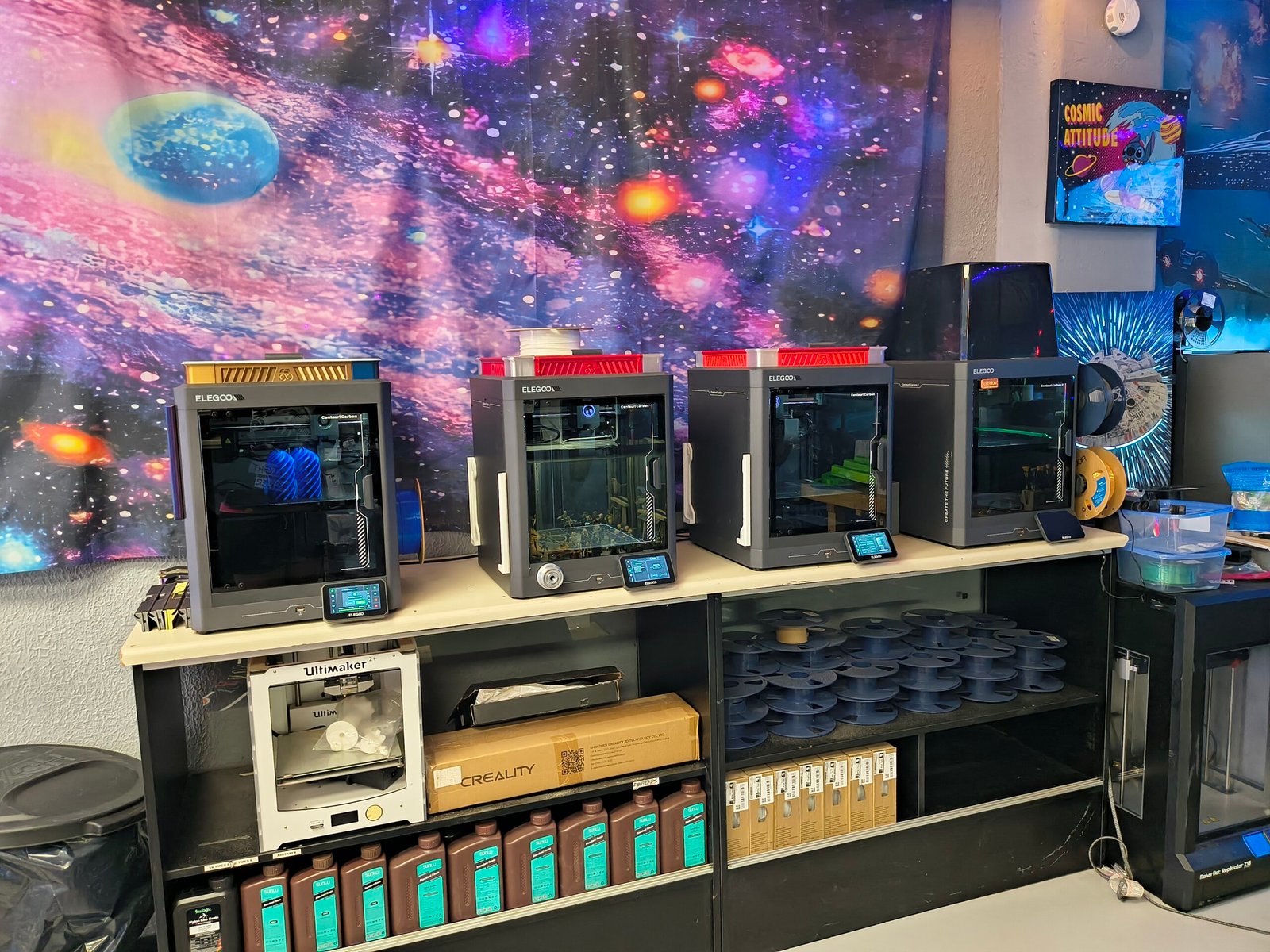
Cosmic 3D helps Del City and Oklahoma City-area makers compare the intended material, printer, nozzle and spool before pickup. We confirm current inventory and price before asking anyone to drive to the store. If an existing spool is suitable, we will say so; if direct feeding is safer or more reliable, we will recommend that instead of an unnecessary purchase.
Frequently asked questions
Can you use third-party filament in a Bambu Lab AMS?
Many third-party filaments can work when the exact material is approved for that AMS generation, the spool fits and rotates correctly, and the printer, nozzle and profile support it. Verify all three conditions before loading or buying multiple spools.
Do cardboard spools work in the Bambu Lab AMS?
Some can work, but cardboard reel quality varies. Bambu Lab's standard AMS guidance recommends an appropriate spool adapter or ring. Measure the reel, inspect its edges and verify that the adapter does not rub, loosen or make the spool too large.
Can TPU be used in every Bambu AMS?
No. Compatibility depends on the TPU product and AMS model. Bambu Lab distinguishes ordinary soft TPU, TPU for AMS and TPU grades intended for AMS HT. Follow the current guide for the exact product and use an approved external-spool path when required.
Why does third-party filament jam in an AMS?
Possible causes include an incompatible flexible material, spool drag, damaged rims, crossed winding, brittle or wet filament, PTFE restrictions, debris or a feeder fault. Locate the resistance before replacing the AMS or printer components.
Should I buy an AMS if I usually print one color?
Not automatically. An AMS can simplify multi-color work and spool management, but an approved external spool holder may be simpler for one-color jobs or incompatible flexible materials. Buy the system only when its benefits match the projects you actually print.