
The short answer: plan for ventilation and source control
A 3D printer changes material with heat or light, and the complete workflow can release particles, vapors or contaminated residue. The amount and type depend on the printer, exact material, temperature, room, number of machines, operating time and post-processing. A printer that smells mild is not automatically emission-free, and a strong odor does not measure the dose.
NIOSH recommends controlling hazards near their source through safer material choices, enclosures, ventilation and filtration before relying on behavior or personal protective equipment alone. EPA likewise advises against running printers in poorly ventilated spaces and recommends combining lower-emitting materials with ventilation, filtration and reduced time near an operating machine.
That does not produce one universal air-change number for every bedroom, classroom or print farm. Start with the exact process and safety data, then involve an industrial hygienist, HVAC professional or applicable authority when the room, occupancy or scale makes the answer consequential.
What a filament printer can release
Fused-filament printers melt thermoplastic at the nozzle. NIOSH and EPA research identifies ultrafine particles and volatile organic compounds as important emission categories. Emission rates vary across printer-and-filament combinations, so a conclusion about one PLA or ABS test should not be presented as a guarantee for another brand, color, additive package or temperature.
The material safety data sheet remains essential for handling and emergency information, but it may not answer every question about heated-process emissions. Check the printer and material manufacturer's current instructions as well as credible process research. Specialty additives, composite fibers and higher processing temperatures can introduce different considerations.
Do not raise nozzle temperature merely to overcome poor feeding until the mechanical and profile causes have been checked. EPA lists lower nozzle temperature, when compatible with successful printing, as one way to reduce emissions. Print quality, layer bonding and manufacturer limits still have to be respected.
PLA is not a permission slip to ignore the room
PLA often has less objectionable odor than materials such as ABS or ASA, but odor and safety are not interchangeable. NIOSH recommends controls across brands and filaments because printer-and-material combinations can behave differently. Use a lower-emitting material where it meets the job, then keep the room and machine controls in the plan.
ABS, ASA, nylon and specialty materials can require more deliberate control. Prusa, for example, warns that ASA releases potentially dangerous fumes and instructs users to print it in a well-ventilated area while avoiding a draft that would destabilize the print. That illustrates an important distinction: room air should be controlled without blowing unpredictable cold air across the part.
A classroom, bedroom or shared office deserves more caution than an isolated, controlled work area because people may remain nearby for long periods. Children, visitors and customers should not become the exposure-control system simply because the printer is quiet.
An enclosure, exhaust and filter do different jobs
An enclosure can contain heat and help keep emissions from dispersing immediately, but containment is not the same as removal. Local exhaust captures contaminated air near the source and sends it to an appropriate outdoor discharge. Filtration recirculates air through media selected for the contaminant.
HEPA filtration is intended for particles. Activated carbon or another suitable gas-phase medium is used for certain vapors. A small filter labeled HEPA does not automatically control gases, and a carbon sheet does not automatically provide sufficient capacity, contact time or replacement indication. Use the manufacturer's documented filter combination and replacement schedule; do not treat an odor reduction as proof of exposure control.
NIOSH describes local exhaust, ventilated enclosures and high-efficiency particle filtration as possible engineering controls. The right choice depends on the material, room and number of printers. An enclosure should also preserve safe temperatures, clearances, wiring and fire response; improvised covers can create heat or electrical risks.
Resin printing adds handling and solvent controls
A resin printer's cover does not contain the entire workflow. Liquid resin, resin-coated tools, washing, drying, curing, spills and waste all need a controlled route. Consult the safety data sheet for the exact resin and wash liquid before selecting ventilation, gloves, eye protection, storage or spill supplies.
Formlabs advises operating its SLA printer and Form Wash where air circulates freely and following the exact material safety guidance. It warns that uncured resin can irritate skin or cause an allergic reaction, calls for suitable chemical-resistant gloves and instructs users not to remove resin from skin with alcohol or another solvent. Other brands and formulations may have different instructions, so transfer no claim from one product to another.
Isopropyl alcohol and other wash fluids can add flammable-vapor and storage concerns. Keep ignition sources, food and drink out of the work area. Collect contaminated liquid and follow the product instructions and local waste requirements rather than pouring it into a drain.
Use a room-by-room decision checklist
Write down the real operating conditions before buying equipment or moving a printer. The goal is to control the source and prevent avoidable exposure, not to attach a fan after the room is already crowded with machines.
- Process: filament, resin, washing, curing, sanding, smoothing or another post-process.
- Materials: exact manufacturer, product, color, additives and current safety data sheet.
- Scale: number of printers, hours per day, temperatures and simultaneous jobs.
- People: children, customers, staff, sleeping occupants, pets and anyone with respiratory or skin sensitivity.
- Controls: enclosure, verified local exhaust, particle filtration, gas-phase filtration and safe discharge location.
- Maintenance: filter replacement, spill response, waste storage and cleaning without spreading contamination.
- Verification: applicable manufacturer instructions, building or fire requirements, and professional exposure assessment when needed.
Practical example: adding printers to a classroom
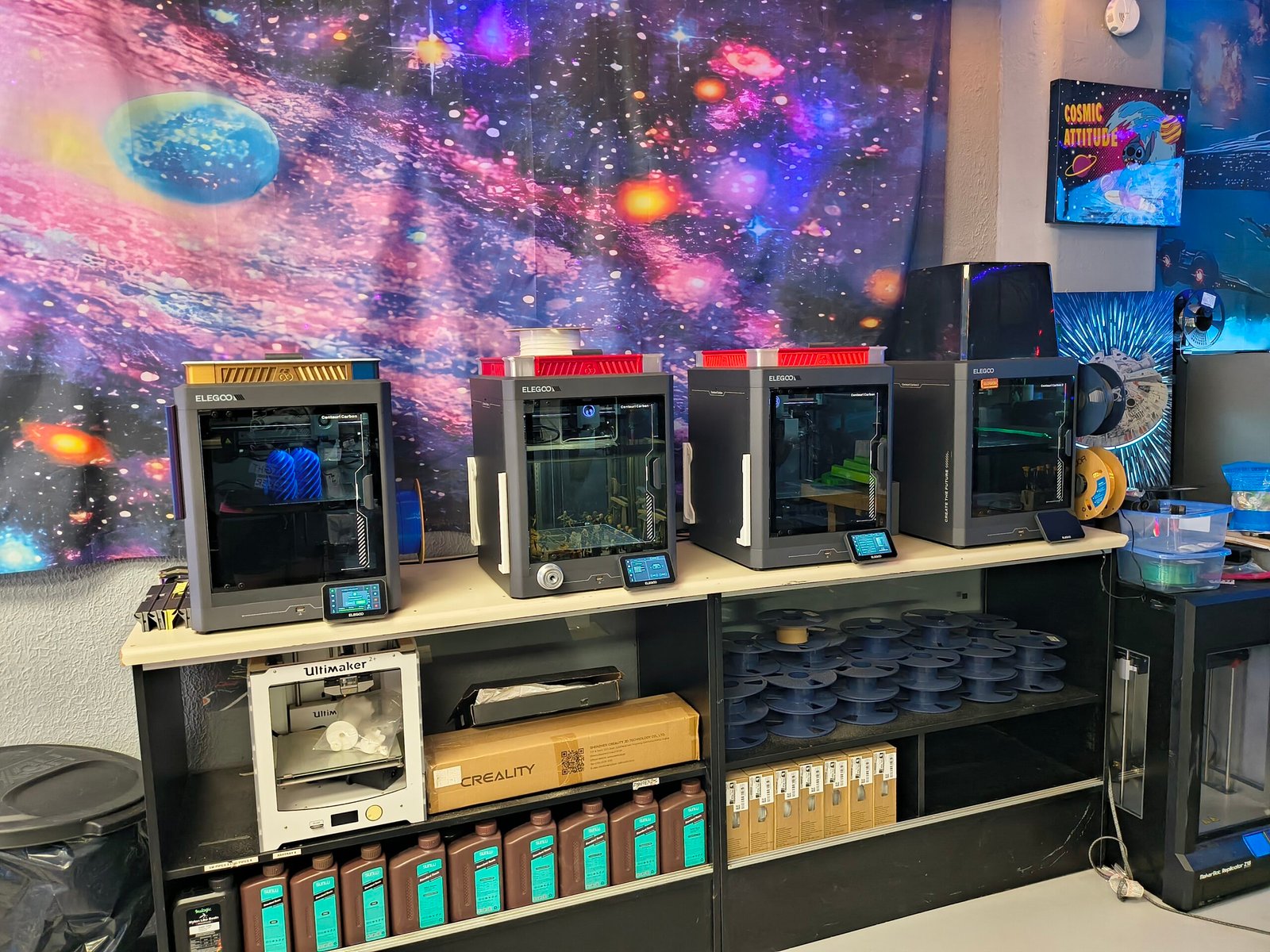
A school plans to place four filament printers at the back of a regularly occupied classroom. The machines are enclosed, so the project is initially described as solved. A customer-first review asks what materials will run, whether the enclosures are exhausted or only closed, where filtered air returns, who replaces filters, how students access hot and moving parts, and whether printers continue through the school day.
The school begins with lower-emitting materials that meet the lesson, limits unnecessary temperature, separates students from operating equipment and asks facilities staff to evaluate source capture and room ventilation. If the space cannot support the process, the better answer may be a dedicated supervised room or outsourcing the prints—not accepting uncontrolled exposure to preserve the equipment purchase.
The same reasoning applies at home. One printer used occasionally is not the same scenario as several printers operating for hours in a sleeping or living space. Change the room or the process before asking people to tolerate a setup that has not been evaluated.
What Cosmic 3D can help verify
Cosmic 3D can help Oklahoma City-area customers compare printer features, identify the exact material and safety documents, review enclosure and filter claims, and plan a workflow that includes printing, cleanup and maintenance. We can also explain when a class, a finished custom print or keeping an existing machine is better value than adding equipment.
We do not certify indoor air quality or replace an industrial hygienist, HVAC professional, fire official or medical professional. If a school, employer, public space or print farm needs an exposure determination, use a qualified resource with the room dimensions, operating schedule, materials and control design.
Bring those facts to the Del City store instead of only a printer model name. Technical references were reviewed November 17, 2026. Confirm the current instructions and safety data for every exact product before changing the workspace.
Frequently asked questions
Do PLA 3D printers need ventilation?
Plan ventilation or another suitable source-control strategy even for PLA. PLA often smells milder than ABS or ASA, but odor is not an exposure measurement and emissions vary by printer, filament, additives and temperature.
Is an enclosed 3D printer safe to use in a bedroom?
An enclosure alone does not prove that emissions are removed, and a bedroom creates long occupied periods. Evaluate the exact material, enclosure, exhaust or filtration and room ventilation; moving the printer to a dedicated controlled area is often the clearer option.
Does a HEPA filter remove 3D-printer fumes?
HEPA media is intended to capture particles. Gas and vapor control generally requires suitable gas-phase media such as activated carbon, with enough capacity and a documented replacement plan. A filter label or reduced odor is not proof that every contaminant is controlled.
Do resin 3D printers need ventilation?
Use the exact resin, printer and wash-fluid instructions. Provide freely circulating air and control the entire workflow, including liquid handling, washing, curing, spills and waste. Follow each product's safety data sheet rather than relying on a low-odor claim.
Can I vent a 3D printer into the attic or another room?
Do not relocate emissions into another occupied or building space. A qualified HVAC or safety professional should determine an appropriate discharge location and confirm that the installation does not create fire, moisture, pressure or code problems.
Can Cosmic 3D certify my printer room as safe?
No. Cosmic 3D can help identify materials, manufacturer instructions and practical control questions, but indoor-air certification or occupational exposure assessment belongs to a qualified industrial hygienist, HVAC professional or applicable authority.